
From Doubt to Buy-In: A CRO’s Guide to Rolling Out Enterprise AI (and Keeping Your Team Onboard)
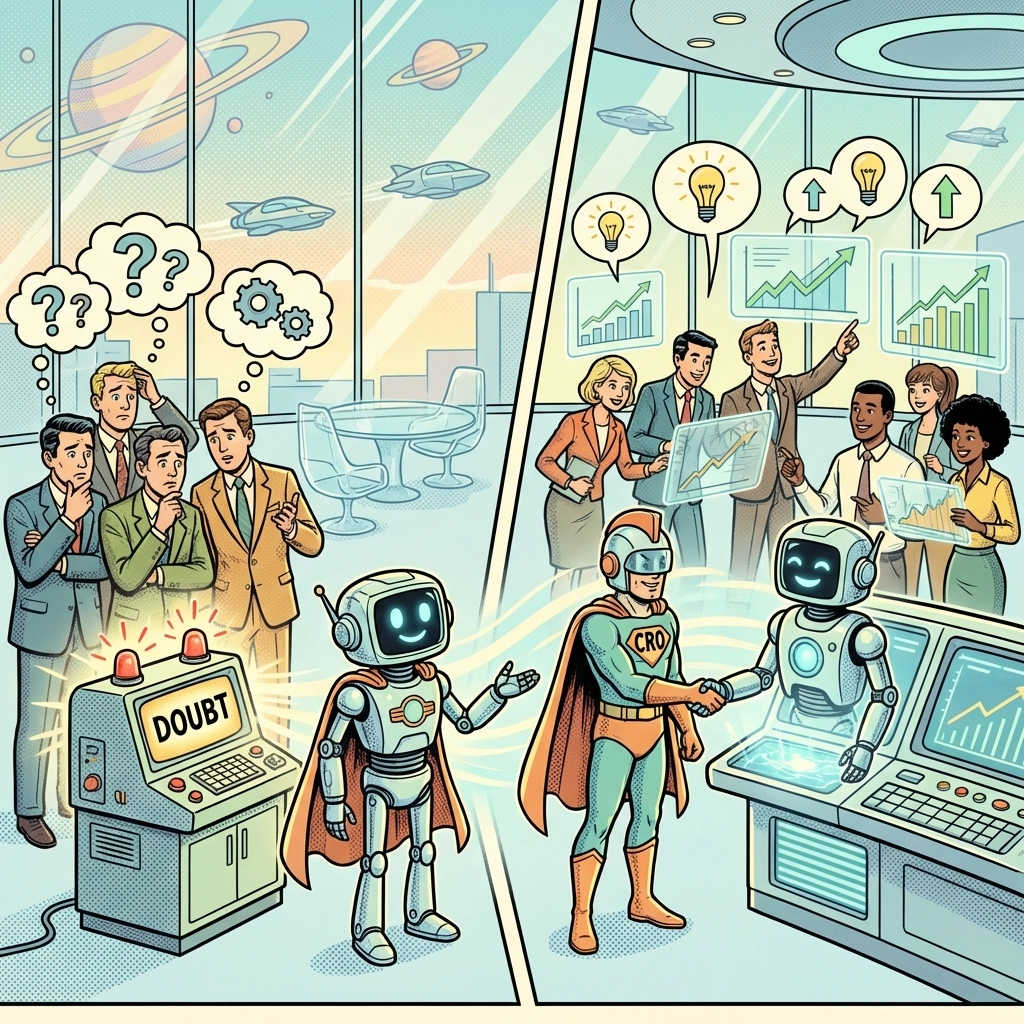
You’re sitting in another executive meeting where AI comes up for the third time this quarter. Your CFO wants to see ROI numbers. Your sales team is asking if robots are going to replace them. And your RevOps leader is drowning in vendor pitches promising to “transform everything overnight.”
Sound familiar? You’re not alone. I’ve watched dozens of enterprise GTM leaders navigate this exact scenario over the past year, and the truth is most AI rollouts fail not because of the technology: but because of the people.
Here’s the reality: your GTM teams don’t need another tool that promises magic. They need practical guidance, clear expectations, and proof that AI will make their jobs better, not obsolete. Let me walk you through how to actually pull this off.
Start With Reality, Not the Hype
The biggest mistake I see CROs make is overselling AI’s immediate impact. Your team has heard the headlines. They’ve seen the demos. They’re expecting either instant transformation or complete job displacement: and both expectations will torpedo your rollout.
Instead, frame AI as continuous improvement, not revolution. When you announce your AI initiative, lead with specific problems you’re solving and realistic timelines. For example: “We’re implementing AI call summarization to give our AEs back 2 hours per week by Q2, not to replace our sales process.”
This approach does two things: it builds credibility with skeptical team members and creates achievable wins that fuel momentum for bigger initiatives later.

Build Your AI Enablement Roadmap (The Practical Version)
Every successful enterprise AI rollout I’ve seen follows the same pattern: they start narrow, prove value, then expand.
Here’s your roadmap:
Phase 1: Personal Productivity Tools (Months 1-2)
Begin with individual AI assistants like ChatGPT or Gemini for content creation, email drafting, and research. These tools feel less threatening because they clearly augment human work rather than replace workflows.
Phase 2: Workflow Integration (Months 3-4)
Introduce AI agents that work behind the scenes: think automated lead scoring, meeting transcription, or pipeline health monitoring. These create value without disrupting daily routines.
Phase 3: Advanced Automation (Months 5-6)
Roll out more sophisticated AI that makes decisions and triggers actions autonomously: like dynamic pricing engines or automated follow-up sequence creation.
The key is proving value at each phase before moving to the next. Your team needs to experience AI making their lives easier, not scarier.
Tackling Personal AI Tools: Making Every Team Member Productive
Let’s start with the low-hanging fruit: personal productivity AI. Your GTM teams are probably already experimenting with ChatGPT or Gemini on their own: often incorrectly and sometimes against company policy.
Create Safe Experimentation Spaces
Set up approved accounts for your team with clear usage guidelines. I recommend starting with specific, bounded use cases:
- For Sales Development: Prospect research and personalized outreach drafting
- For Account Executives: Call preparation and follow-up email composition
- For Customer Success: Knowledge base searches and escalation summaries
- For Marketing: Campaign ideation and content variant testing
Establish Your Training Framework
Don’t just hand people access and hope for the best. Create practical training sessions focused on real scenarios your team faces daily. For example, instead of teaching “how to use LLMs,” teach “how to research enterprise prospects using LLMs in 5 minutes or less.”
Record these sessions and create a searchable library. Your team will reference these resources repeatedly as they build confidence.

Rolling Out Background AI Agents: The Stealth Approach
Here’s where most enterprise AI initiatives either soar or crash: background automation that actually changes how work gets done. The secret is making AI invisible initially, then gradually revealing how it’s helping.
Start With Data Enhancement
Begin with AI that enriches existing data without changing workflows. Lead scoring models, contact data enrichment, and pipeline health indicators all add value while feeling familiar to your team.
Layer in Decision Support
Next, introduce AI that provides recommendations rather than taking actions. For example, an AI agent that suggests which leads to prioritize based on engagement patterns, or which accounts are at risk based on usage data.
Graduate to Autonomous Actions
Only after your team trusts AI recommendations should you move to autonomous actions like automated task creation, email sequences, or dynamic pricing adjustments.
Addressing the Elephant in the Room: Job Security Fears
Let’s be honest about what your team is really worried about. They’re not afraid of learning new technology: they’re afraid of becoming irrelevant. Address this head-on, but do it with specifics, not platitudes.
Reframe AI as Skill Amplification
Show your team exactly how AI amplifies their existing skills rather than replacing them. An experienced AE doesn’t lose value when AI helps them research prospects: they become exponentially more effective because they can have more informed conversations.
Create AI Champions, Not AI Victims
Identify early adopters who are excited about AI and make them your internal champions. Give them advanced training, special projects, and recognition for innovative AI applications. Their enthusiasm will be contagious.
Be Transparent About Changes
Don’t pretend that AI won’t change roles: it will. But position these changes as evolution, not elimination. Administrative tasks will decrease, strategic thinking will increase. Data entry will diminish, relationship building will grow. Paint a picture of more interesting, higher-value work.
Building Trust Through Governance and Transparency
Your team’s confidence in AI directly correlates with their confidence in how you’re managing it. Establish clear governance from day one, and make it visible.
Create Your AI Governance Framework
- Data Protection: What data can AI access? How is it secured?
- Decision Boundaries: What can AI decide autonomously vs. what requires human approval?
- Audit Mechanisms: How do you track AI actions and decisions?
- Rollback Procedures: What happens if something goes wrong?
Make Security a Team Effort
Involve your information security team from the start, not as an afterthought. When your GTM teams see that security is asking the right questions and setting appropriate boundaries, it builds confidence that AI is being deployed responsibly.

Measuring Success: What Actually Matters
Forget the vanity metrics. Your AI rollout succeeds when your team adopts the tools consistently and sees tangible improvements in their daily work. Track these leading indicators:
Adoption Metrics That Matter
- Daily active users of AI tools
- Time saved on administrative tasks (measured in hours, not percentages)
- Increase in meaningful customer touchpoints per rep
- Reduction in routine task completion time
Business Impact Indicators
- Pipeline velocity improvements
- Lead qualification accuracy increases
- Sales close rate increases
- Customer satisfaction scores (AI should improve, not degrade, customer experience)
- Revenue per rep growth (the ultimate measure)
Maintaining Momentum: The Long Game
Your AI enablement doesn’t end when everyone has access to the tools. The most successful enterprise AI rollouts I’ve seen treat enablement as an ongoing discipline, not a one-time project.
Create Continuous Learning Loops
Schedule monthly “AI wins” sessions where team members share successful use cases and problem-solving approaches. These peer-to-peer learning moments are often more powerful than formal training.
Evolve Your Use Cases
As your team becomes more comfortable with AI, gradually introduce more sophisticated applications. The account executive who started using AI for email drafting might evolve to using it for deal strategy development or competitive intelligence.
Stay Connected to Your Team’s Reality
Regular check-ins with frontline users will tell you more about your AI rollout’s success than any dashboard. Are they actually using the tools? What frustrations are they experiencing? Where are they seeing unexpected benefits?
The Path Forward
Rolling out enterprise AI successfully isn’t about finding the perfect technology: it’s about helping your people succeed with imperfect but improving technology. Focus on practical wins, address real concerns, and build confidence through transparency and support.
Your GTM team doesn’t need to become AI experts overnight. They need to see that AI makes their jobs more interesting, more effective, and more human: not less. When you get that balance right, the technology adoption takes care of itself.
The organizations that thrive in our AI-augmented future won’t be the ones with the most sophisticated algorithms. They’ll be the ones with the most confident, capable teams who see AI as their competitive advantage, not their replacement.

