
From Legacy to AI-First: A 5-Step Guide to Modernizing Your Enterprise RevOps

You don’t need to rip out your entire GTM tech stack to get AI working for you.
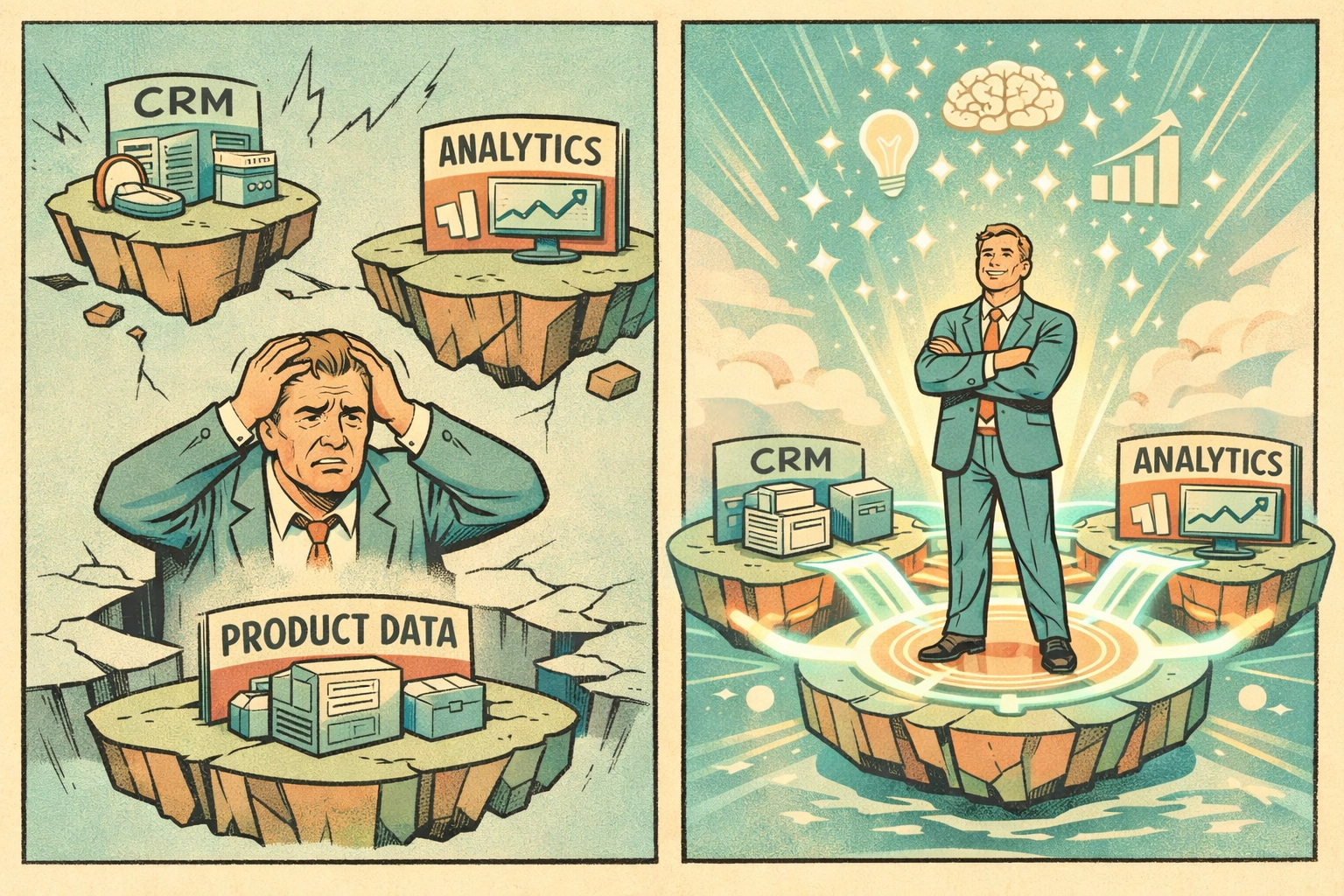
I know that’s what every vendor is telling you right now. “Replace your CRM!” “Throw out your legacy systems!” “Start from scratch!” But here’s the truth: your Salesforce instance, your HubSpot workflows, your Microsoft D365 setup: they’re not the problem. The problem is that they’re sitting there like islands, disconnected from the intelligence layer that could turn them into revenue-generating machines.
The good news? You can modernize your enterprise RevOps without burning everything down. You just need a blueprint that layers AI intelligence onto what you’ve already built. That’s exactly what this guide is about.
Why “Legacy” Doesn’t Mean “Broken”
Before we dive into the how, let’s kill a myth: your existing tech stack isn’t holding you back. What’s holding you back is treating it like a filing cabinet instead of a nervous system.
Your CRM has years of customer behavior data. Your marketing automation platform knows what converts. Your product analytics understand usage patterns. The issue isn’t the tools: it’s that they’re not talking to each other in a way that drives intelligent action.
Enterprise marketing operations teams are drowning in data but starving for insights. You have dashboards everywhere, but you’re still manually building lists, guessing at ICP fit, and running campaigns based on gut feel rather than predictive intelligence.
That changes when you shift from legacy operations to AI-first revenue operations.
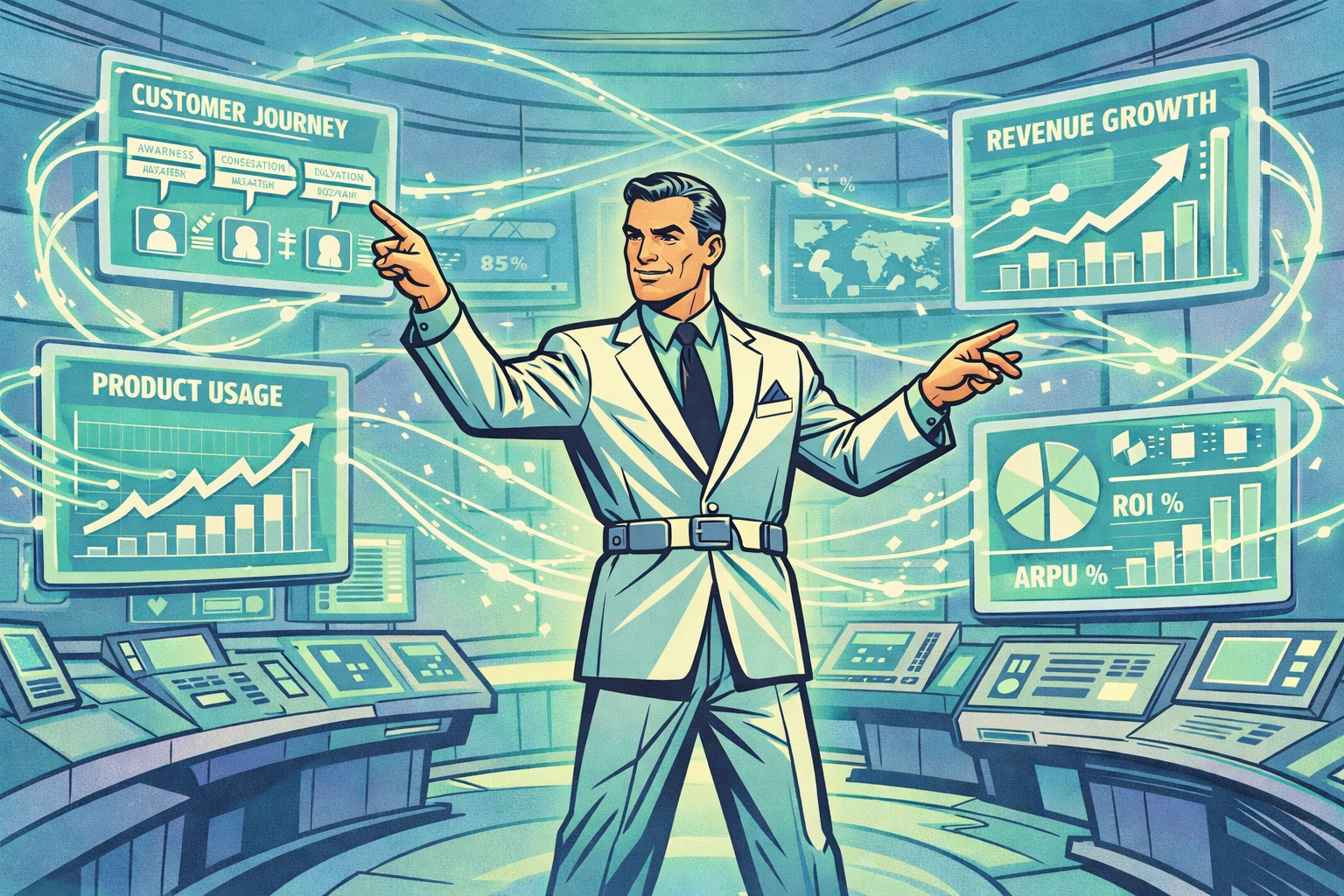
The 5-Step Framework: From Reactive to Predictive
Here’s how you modernize without the chaos. This isn’t theory: this is the exact framework we use at FusedLabs to help B2B SaaS companies activate their product data and transform their GTM motion in 90 days.
Step 1: Audit Your Current Tech Stack and Data Flows
You can’t layer AI onto chaos. Start by mapping exactly where your data lives and how it moves between systems.
Ask yourself:
- Where does product usage data currently land? (Spoiler: it’s probably stuck in your analytics tool.)
- How long does it take for a product signal to reach your sales team?
- Which systems are your single source of truth for customer health, expansion signals, and churn risk?
The most common bottleneck I see? Product data never makes it into the CRM. Your engineering team built an amazing product analytics setup, but Marketing Ops is running campaigns based on demographic data from 2023. Sales is pitching features that customers already use (or worse, already churned from).
This audit isn’t about finding problems: it’s about identifying integration points where AI can create leverage. In our first 30 days working with clients, we focus exclusively on connecting these data flows so intelligence can move at the speed of your customer lifecycle.
Step 2: Establish Data Governance and Quality Foundations
AI is only as good as the data you feed it. And if your CRM has duplicate records, your lead scoring is based on incomplete enrichment, or your lifecycle stages are inconsistently applied, you’re building on quicksand.
Here’s what enterprise RevOps teams need before adding AI into the mix:
Standardized data definitions across Sales, Marketing, and Customer Success. What counts as an MQL? What triggers an expansion opportunity? Get everyone aligned on the same vocabulary.
Automated data quality checks that run daily. Set up validation rules in Salesforce, HubSpot, or D365 that flag incomplete records, outdated contact info, or missing account hierarchies before they poison your AI models.
Clear ownership and stewardship. Assign someone (or a team) to be responsible for data integrity. Weekly reviews. Monthly reconciliations. This isn’t sexy work, but it’s the foundation of every successful AI implementation I’ve seen.
You don’t need perfect data to start: but you do need consistent data. AI can handle messy inputs if the structure underneath is sound.

Step 3: Layer AI Intelligence onto Existing CRM Infrastructure
Here’s where the magic happens. You’re not replacing Salesforce, HubSpot, or Microsoft D365: you’re making them smarter.
This step is about integration, not replacement. Modern AI revenue operations tools plug directly into your existing CRM and enrich it with predictive layers:
- Lead scoring that actually works because it’s trained on product usage signals, not just demographic fit
- Expansion identification that flags accounts showing usage patterns that historically convert to upsells
- Churn prediction that gives your CS team 60-day warnings instead of post-mortem reports
The key is choosing AI tools that respect your existing workflows. Your sales team shouldn’t have to leave Salesforce. Your marketers shouldn’t have to abandon their HubSpot campaigns. The AI should surface insights inside the tools they already use.
At FusedLabs, we activate product data to create these intelligence layers in real time. When a customer hits a usage threshold, your CRM updates automatically. When an account shows expansion signals, a task gets assigned. When churn risk spikes, an alert fires. All without your team lifting a finger.
This is what AI in marketing ops actually looks like: automation that drives revenue, not just efficiency.
Step 4: Automate Cross-Functional Workflows and Handoffs
The biggest bottleneck in enterprise GTM isn’t technology: it’s the handoff between teams.
Marketing generates a lead, but it sits in a queue for 48 hours before Sales touches it. Sales closes a deal, but Customer Success doesn’t get the full context of what was promised. CS identifies an expansion opportunity, but it gets lost in a weekly report that nobody reads.
Marketing ops automation should eliminate these gaps entirely. Here’s what that looks like in practice:
- Lead assignment automation based on territory, product fit, and real-time capacity
- Lifecycle stage progression triggered by product usage milestones, not manual updates
- Slack alerts and task creation when high-value accounts hit critical thresholds
The goal isn’t just speed: it’s intelligent orchestration. You want the right message, to the right person, at the right time, based on what the data is telling you about their journey.
This is where enterprise CRO efficiency gets unlocked. When your GTM motion is orchestrated by AI instead of spreadsheets and Slack threads, you free up your team to focus on strategy instead of logistics.
Step 5: Activate Product Data for Predictive GTM Intelligence
This is the step that separates the leaders from the laggards in 2026.
Your product holds the richest behavioral data you have access to. Every feature adoption. Every usage spike. Every drop-off. This is the signal that tells you who to expand, who to nurture, and who to save before they churn.
But most B2B SaaS marketing automation systems never tap into it. Why? Because product data lives in Mixpanel, Amplitude, or your data warehouse: and nobody’s built the bridge to connect it to your GTM stack.
That’s the breakthrough. When you activate product data inside your CRM and marketing automation platform, you shift from reactive reporting to predictive action:
- Run campaigns targeting users who adopted Feature X but haven’t explored Feature Y (the gateway to expansion)
- Trigger onboarding sequences based on actual usage patterns, not time-based drip campaigns
- Score accounts for renewal risk using engagement trends, not survey responses
This is the core of what we do at FusedLabs. We connect your product analytics to your GTM systems so your revenue teams operate with the same intelligence your product team has. And we do it in 30 days, with full transformation in 90.
The Outcome: Enterprise RevOps That Thinks Ahead
When you modernize this way: by layering intelligence onto what you’ve already built: you don’t just get faster operations. You get smarter strategy.
Your enterprise GTM becomes predictive instead of reactive. Your marketing analytics AI doesn’t just tell you what happened last quarter: it tells you which accounts to focus on next quarter. Your RevOps team stops firefighting and starts orchestrating.
And the best part? You didn’t have to rebuild your entire tech stack to get there.

Ready to modernize your enterprise RevOps without the rip-and-replace chaos? Let’s talk. FusedLabs helps B2B SaaS companies activate their product data and transform their GTM motion: starting with results in 30 days and full transformation in 90. Let’s build your AI-first revenue engine together.

