
Why Integration Isn’t Enough: Moving Toward AI Orchestration in Enterprise RevOps

If you’re a Chief Revenue Officer or a VP of RevOps today, you’re living inside a specific kind of paradox. Every board meeting opens with the same question: “What’s our AI strategy?” And you have answers – you’ve turned on the generative AI features in Salesforce or HubSpot, plugged a predictive scoring tool into Marketo, and integrated an AI note-taker into your Zoom calls. On paper, you’re an AI-powered organization.
But look at your team’s daily workflow. Your reps are still jumping between five tabs to understand a single prospect. Your managers are still manually cleaning data to produce a halfway decent forecast. The tools are new. The work hasn’t changed.
We call this AI Theater – it demos well, but it doesn’t drive revenue. And the root cause is a strategic one: most enterprises have focused on AI integration when what they actually need is AI orchestration.
The Divide: Integration vs. Orchestration
To move the needle in a B2B SaaS environment, we have to stop treating AI as a feature we bolt onto existing tools and start treating it as the connective tissue of the entire Go-To-Market stack.
Integration
Integration is the first step most teams take, and it’s a necessary one. It’s a point-to-point connection: an AI tool summarizes leads in your CRM, an agent notifies you in Slack when a deal changes stage. It’s functional, but it’s siloed. The AI in your marketing stack doesn’t talk to the AI in your sales stack. They don’t share context. They don’t learn from each other. You’ve connected systems, but you haven’t managed the intelligence flowing between them.
Orchestration
Orchestration is what happens next. It’s the difference between a group of talented solo musicians and a world-class symphony. In an orchestrated model, a central intelligence layer, often powered by specialized AI agents, coordinates multiple models, tools, and workflows so they operate as a single system.
Here’s what that looks like in practice: a trial user hits a specific product usage milestone. An orchestrated system sees that signal, triggers personalized outreach via your marketing automation platform, updates the CRM opportunity with the exact intent data, and briefs the Account Executive on the pain point to address – all without a human touching a keyboard. Integration could handle any one of those steps. Orchestration handles the sequence.

Why Integration Alone Becomes Technical Debt
In our work with SaaS companies in the $5M–$50M ARR range, we’ve seen a consistent pattern: companies invest six figures in AI tooling only to discover they’ve built faster silos.
When you layer AI onto existing workflows, especially messy ones, you accelerate your current inefficiencies. If your CRM data is unreliable, AI will generate hallucinated insights faster than any human could. If your marketing leads aren’t mapped to product usage data, AI-driven outreach will feel disjointed and robotic to your buyers.
The compounding costs show up in three places:
- Model Conflict. Different AI models give contradictory recommendations for the same lead. Your scoring tool says “hot,” your intent model says “dormant,” and your rep has no way to adjudicate.
- Fragmented Intelligence. AI-generated insights get trapped inside individual tools instead of being accessible across the GTM stack. Your marketing team sees one version of reality; your sales team sees another.
- The Opacity Problem. No visibility into why an AI tool made a specific recommendation. RevOps can’t audit it. Leadership can’t trust it. And when you can’t explain a decision, you can’t optimize the system that produced it.
The Missing Foundation: Product Usage Data
You cannot orchestrate a GTM strategy if your AI doesn’t know what your customers are actually doing inside your product.
Most RevOps teams still rely on static firmographic data – title, company size, industry. That data matters, but in modern SaaS, the highest-signal information is behavioral. Are users logging in? Which features are they engaging with? Where are they getting stuck? When does usage spike before an expansion conversation, and when does it drop before churn?
This is why orchestration demands a clean data foundation where product usage data is fused with your CRM and marketing automation data. Without it, your AI is making decisions based on a profile, not a pattern. You’re building a high-performance engine without fuel.
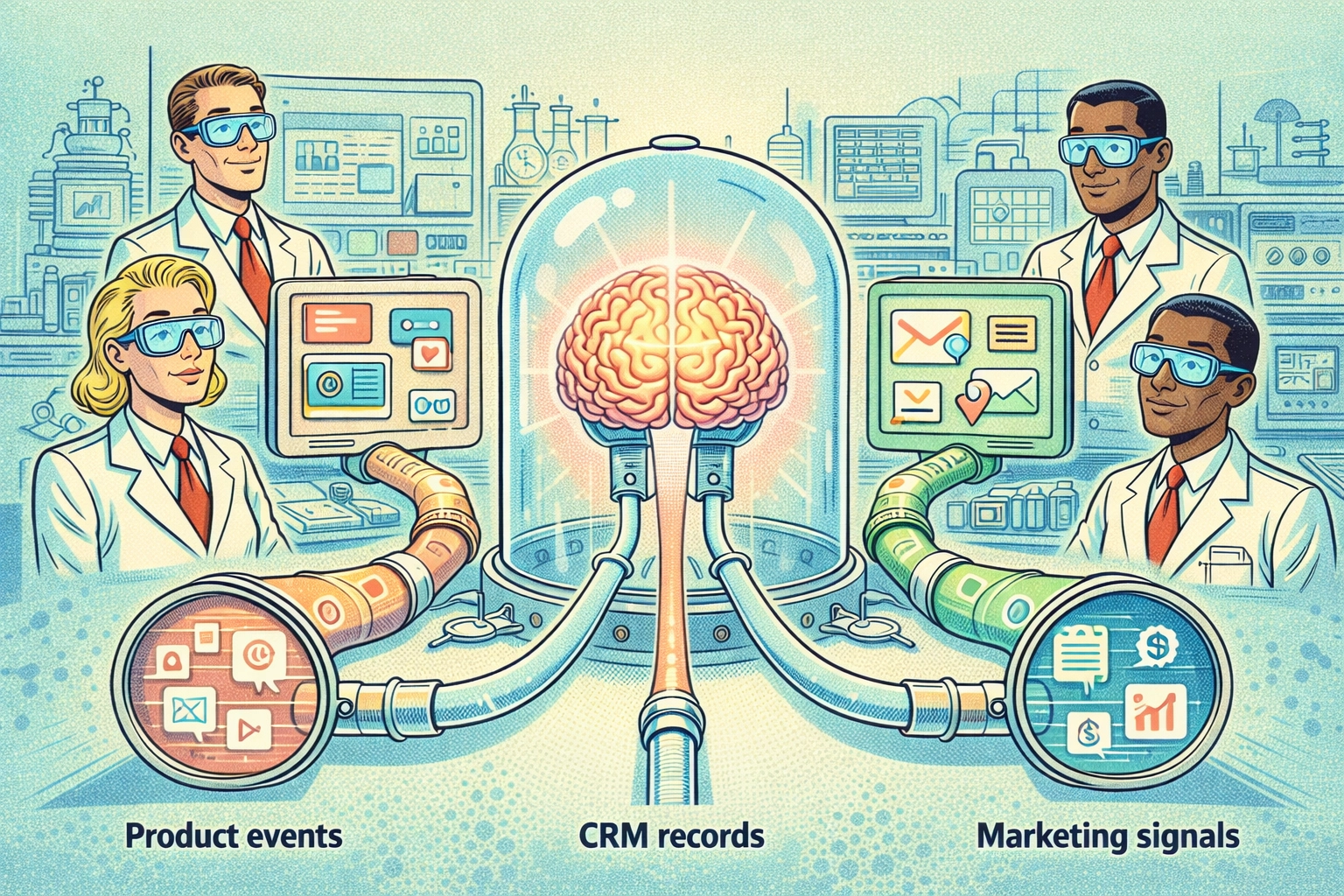
When you connect these data sets, the shift from reactive reporting to proactive execution becomes possible. That’s the architecture of a GTM stack built for 2026 – one that doesn’t break under pressure.
The CRO’s Case: Efficiency, Insight, and Predictable Growth
For an enterprise CRO, orchestration isn’t a technology upgrade. It’s a financial one.
- Efficiency that scales. Orchestration eliminates the coordination tax. Instead of RevOps spending 20 hours a week on manual lead routing, data reconciliation, and handoff logistics, autonomous agents handle the plumbing, freeing your team to focus on strategy.
- Context-rich customer engagement. Because the AI has visibility across the full stack, including CRM, marketing automation, and product analytics, it provides deep context to your reps. No more “just checking in” emails. Every touchpoint becomes relevant and value-driven.
- Forecasting that earns trust. When your systems are orchestrated, your forecast is built on patterns across the entire funnel, not pipeline snapshots and gut feel. The AI can surface churn risks and expansion signals months before they’d show up in a quarterly review.
A Practical Path: Three Steps from Integration to Orchestration
Moving to orchestration doesn’t require a multi-year transformation. Here’s how we approach the shift with our clients.
Step 1: Audit and Foundation
We don’t start by purchasing more tools. We start by mapping your current data flow, tracing how information moves (or doesn’t move) between your CRM, marketing automation, product analytics, and customer success platforms. The goal is to identify where intelligence leaks are happening: where data is duplicated, where it’s stale, where it never arrives at all.
During this phase, we prioritize integrating product usage data into the GTM stack. If your AI doesn’t have behavioral signals to work with, orchestration has nothing to orchestrate. For one mid-market SaaS client, this audit alone revealed that 40% of their Salesforce opportunity data had no connection to actual product engagement, meaning their forecasting model was essentially guessing.
Step 2: Deploy the Orchestration Layer
Once the foundation is clean, we activate the intelligence layer. This is where we deploy autonomous agents that don’t just connect to your tools but coordinate them, watching data flows in real time, identifying anomalies, suggesting workflow optimizations, and ensuring your GTM strategy executes consistently across every segment, time zone, and region.
Step 3: Measure, Optimize, and Scale
With orchestration live, we shift into a continuous improvement cycle. We benchmark the system against the metrics that matter – lead response times, pipeline quality, forecast accuracy, and RevOps hours recovered. From there, we expand orchestration into adjacent workflows: onboarding, renewal signals, cross-sell triggers. The goal is a system that gets smarter with every quarter, not one that requires a new integration project every time priorities shift.
The difference is immediate and measurable: faster lead response, higher-quality pipeline, and a RevOps team that spends its time on analysis instead of administration.

The gap between companies that orchestrate their AI and companies that simply integrate it is widening. Integration was the right first step. But treating AI as a collection of disconnected features, each solving one narrow problem inside one narrow tool, creates a new kind of technical debt that compounds with every quarter.
The companies pulling ahead in 2026 are the ones that made a different choice: they stopped optimizing individual tools and started architecting the system those tools live inside.
If you’re weighing that shift for your own GTM stack, we’d welcome the conversation.

