
Stop Wasting Budget on “AI Theater”: A Strategic Guide for Enterprise CROs

You’ve been in that boardroom. A competitor announces their “revolutionary AI-powered revenue engine.” Your board sees the coverage. Your CEO forwards you the article with a single question mark. And suddenly, you’re under pressure to roll out enterprise AI by next quarter: not because your revenue operations needs it, but because everyone else seems to be doing it.
This is how billions get wasted on what I call “AI Theater”: impressive announcements disconnected from operational reality. And as a CRO, you’re uniquely positioned to either fall into this trap or build something that actually transforms your enterprise GTM.
Let me show you the difference.
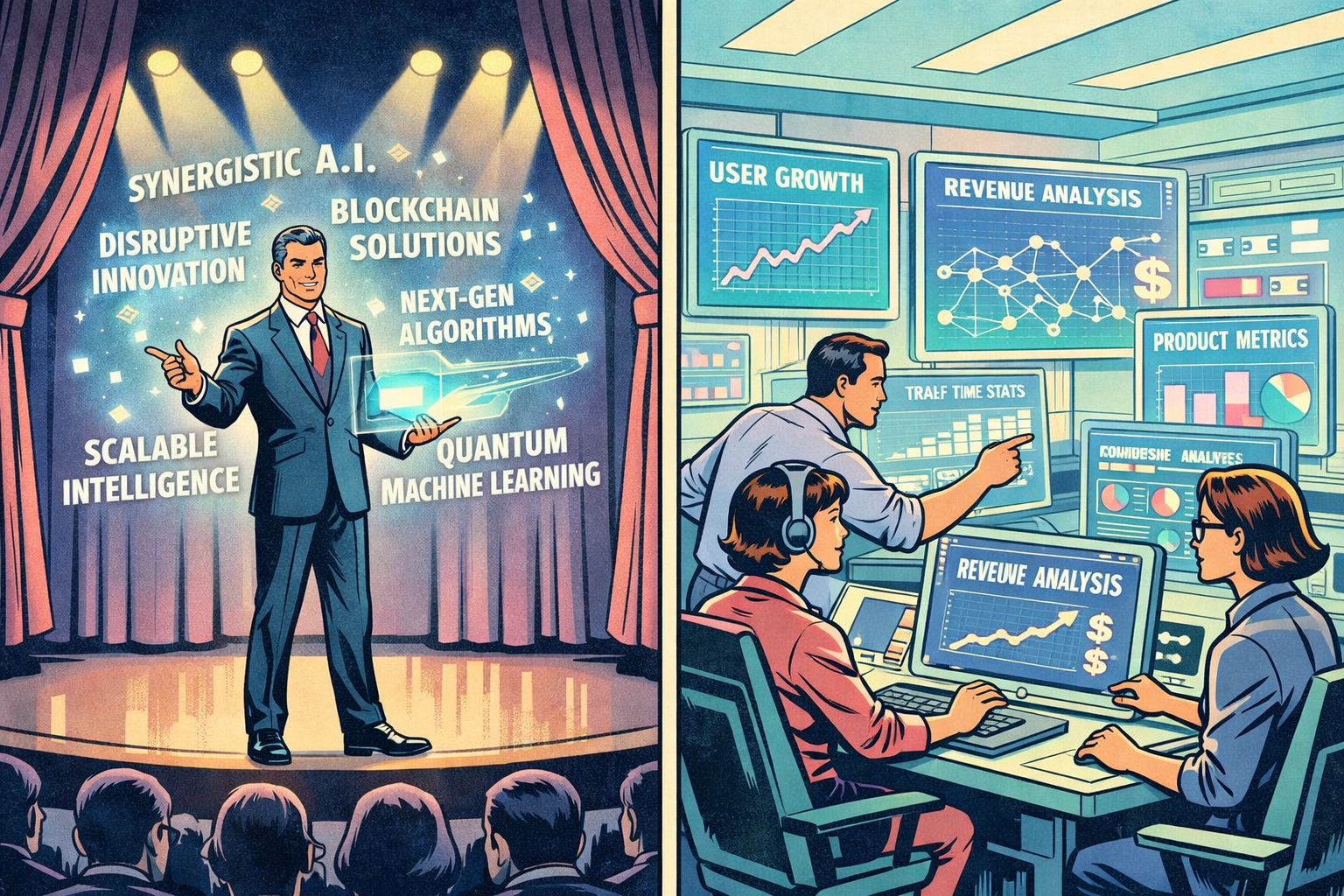
What AI Theater Actually Looks Like
AI Theater has four distinct markers, and you’ve probably seen all of them:
Vague implementation details. Your competitor announces “AI deployed across our entire revenue stack” but can’t tell you what it actually does, how many processes it touches, or what success looks like. Real AI implementations come with concrete numbers because operational teams work with them every day.
One-time announcements followed by silence. Theater generates initial coverage, then disappears. No follow-up metrics. No expansion plans. No customer stories. Authentic success gets discussed repeatedly as you expand scope and share quantified results.
Perpetual pilot phase. Theater keeps initiatives always “just deployed” or “coming soon.” Real implementations reach maturity: your teams talk about lessons learned, challenges overcome, and how capabilities evolved after 18+ months of actual use.
Executive-only communication. Theater lives in press releases and marketing materials. Real AI implementations change observable business operations so profoundly that your revenue teams naturally mention them in industry conversations and conferences because it’s genuinely how they work.
Why Smart CROs Still Fall for Theater
The pressure cascade is predictable. Competitors announce AI capabilities. Your board sees coverage. Leadership wants a plan to close the perceived competitive gap. The result? You’re solving a perception problem by creating an actual operational problem.
Here’s what I’ve seen firsthand: The expensive mistake isn’t implementing AI: it’s implementing AI reactively based on competitor marketing rather than your own revenue-generating business needs.
You end up with:
- Disconnected tools that don’t talk to your enterprise marketing operations
- AI agents making decisions without understanding your enterprise GTM context
- Marketing ops automation that automates broken processes
- Zero ROI because you never had a data strategy
This is where most enterprise CROs lose millions in budget and months of momentum.
The Foundation Nobody Talks About: Your Product Data
Before you even think about AI agents or marketing analytics AI, ask yourself one brutal question: Do you actually know what your customers are doing inside your product?
Most enterprise RevOps stacks are built on demographic and engagement data: who your customers are and what marketing emails they opened. But the gold mine sitting untapped is your product usage data. Which features drive retention? Which behaviors signal expansion opportunity? Which usage patterns predict churn?
This is where enterprise CRO efficiency actually begins. Not with more AI tools: with activating the data you already have.
Here’s the reality: AI without clean, unified product data is just expensive guessing. But AI with activated product data becomes a legitimate competitive advantage in your enterprise GTM.

Layering AI Onto Your Existing Enterprise Stack (Without Ripping Everything Out)
You’re already running Salesforce, HubSpot, or Microsoft Dynamics 365. You’ve invested millions in these enterprise marketing operations platforms. The last thing you need is another consultant telling you to rip it all out and start over.
Instead, here’s the strategic approach that actually works:
Step 1: Audit your data foundation. Before adding AI capabilities, map where your product data lives, how it flows (or doesn’t flow) into your CRM, and what signals are completely invisible to your revenue teams. This is your baseline.
Step 2: Unify your data layer. Connect your product data to your existing enterprise stack. This isn’t a replacement: it’s an enhancement layer that makes your Salesforce or HubSpot exponentially smarter by adding product usage context to every account.
Step 3: Layer intelligence strategically. Start with high-impact, low-complexity AI applications in marketing ops automation: lead scoring that incorporates product signals, account health monitoring that combines engagement and usage data, expansion opportunity detection based on actual product behavior.
Step 4: Scale with governance. As AI begins making recommendations or taking actions, establish clear governance structures. Who has authority over AI-driven decisions? What data quality standards must be maintained? What human oversight remains critical?
This approach to AI revenue operations respects your existing investment while dramatically expanding what’s possible.
The FusedLabs Timeline: Results to Transformation in 3 Steps
Here’s where theory meets reality. Most AI implementations drag on for months with no visible impact. You need results that prove ROI before your board loses patience.
First Step: Quick Wins
- Audit your current data architecture and identify the biggest gaps between product reality and CRM visibility
- Implement initial product data connections to your existing enterprise stack
- Deploy AI-enhanced lead scoring that incorporates product usage signals
- Deliver your first set of insights that change how your revenue teams prioritize accounts
These aren’t pilot projects. These are operational improvements that your teams use immediately.
Second Step: Operational Integration
- Expand AI capabilities across your enterprise marketing operations: account health scoring, churn prediction, expansion opportunity identification
- Train your revenue teams on how to interpret and act on AI-driven insights
- Establish feedback loops so your AI gets smarter based on actual outcomes
- Begin measuring lift in key metrics: conversion rates, expansion revenue, retention improvement
Third Step: Full Transformation
- Complete integration of AI revenue operations across your entire enterprise GTM
- Autonomous workflows handling routine decisions while surfacing strategic opportunities for human judgment
- Documented ROI demonstrating clear lift in enterprise CRO efficiency metrics
- Roadmap for continuous improvement and capability expansion
This isn’t AI Theater. This is operational transformation with measurable business impact in a timeline that makes sense for enterprise decision-making.

The ROI Question: Efficiency vs. Expanded Capability
Before you allocate a single dollar to AI in marketing ops, force your organization to answer two fundamental questions:
1. Does it improve an existing capability or create a new one?
Improving existing capabilities (better lead scoring, faster account insights, more accurate forecasting) is lower-risk and delivers faster ROI because you’re executing patterns your teams have already validated. Creating new capabilities is higher-value long-term but requires more organizational change management.
2. Is the primary value efficiency or expanded capability?
Leadership often expects fewer people and faster timelines. But the most durable value from marketing analytics AI is actually teams doing more high-quality strategic work: better thinking, stronger creative instincts, more intentional operations. Things they previously lacked time to do well.
Misalignment on these questions is why leadership ends up quietly disappointed with AI results. Get crystal clear on what success looks like before you invest.
How to Recognize Real AI Implementations (Including Your Own)
Here’s your litmus test for whether you’re building something real or just funding theater:
Observable business results. Can you point to specific revenue outcomes that improved because of your AI implementation? Not “we deployed AI”: actual numbers on conversion lift, retention improvement, or expansion revenue increase.
Ongoing iteration. Real implementations evolve continuously. Your teams talk about what they learned last month and what they’re optimizing next month. Theater has one launch announcement and then silence.
Integration into daily workflows. Your revenue teams use AI-driven insights without thinking about it: it’s just how they work now. Theater lives in separate dashboards nobody actually opens.
Clear ROI documentation. You can articulate exactly what you invested, what capabilities you gained, and what business impact resulted. Theater has vague promises about “future value.”
If your AI implementation passes these tests, you’re building enterprise CRO efficiency that compounds over time. If not, you’re funding theater.
Stop Reacting to Competitor Noise
Let competitors spend money on AI Theater. Organizations that implement AI based on solid business cases and actual revenue impact will outcompete those with impressive announcements disconnected from operational reality.
The competitive advantage goes to revenue leaders who invest strategically rather than reactively: who build on solid data foundations rather than chasing headlines.
Your move as a CRO isn’t to match competitor announcements. It’s to build AI-driven revenue operations that transforms how your enterprise GTM actually operates. To layer intelligence onto your existing enterprise marketing operations stack in ways that compound over time. To deliver measurable ROI in timelines that make sense for your business.
That’s not theater. That’s transformation.
And if you’re ready to understand what real AI implementation looks like for your enterprise RevOps stack: without the theater: let’s talk about your specific situation. Because the best time to build your data foundation was yesterday. The second best time is right now.

