
The Enterprise GTM AI Strategy: Moving Beyond the Pilot Phase
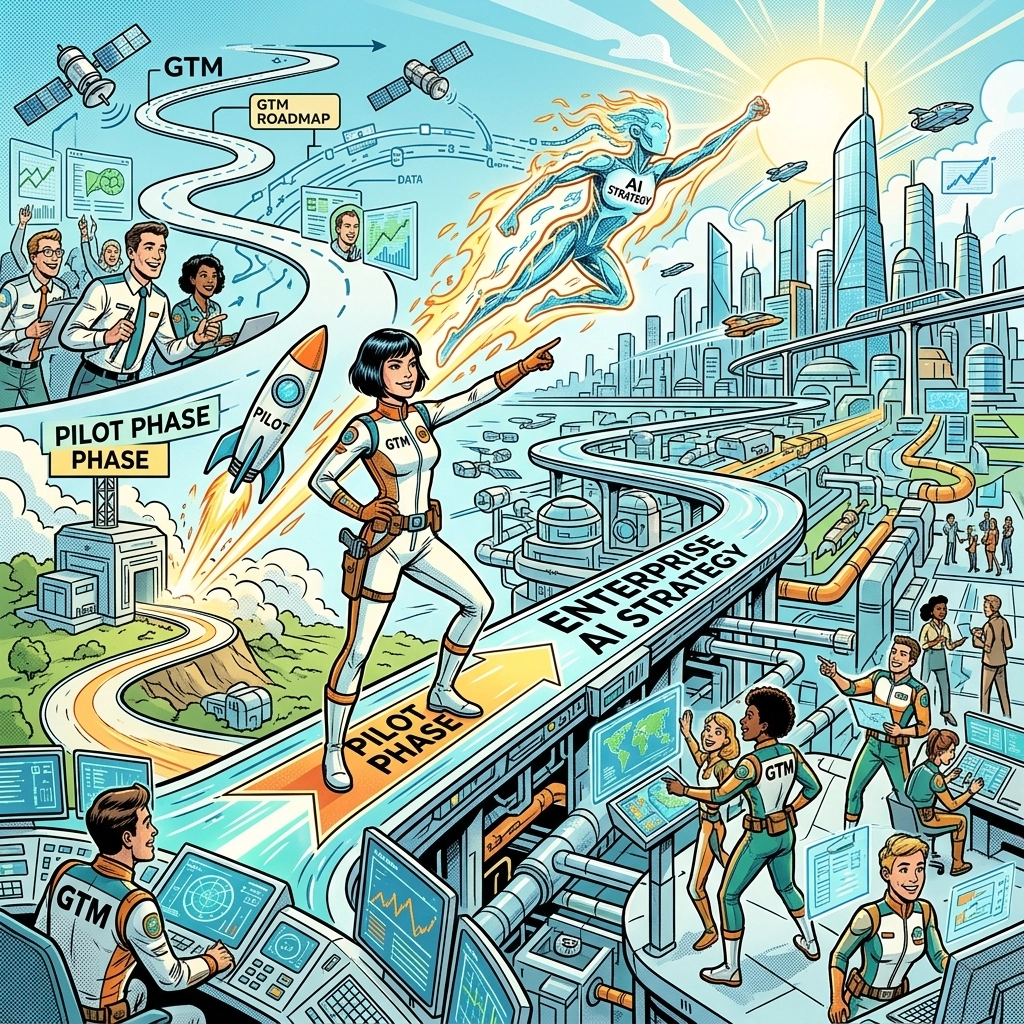
Let’s be honest for a second. If you’re leading an enterprise GTM team right now, you’re likely exhausted by the “AI hype cycle.” Your inbox is a graveyard of pitches for “world-changing” chatbots, and your internal Slack channels are filled with links to the latest LLM benchmarks. You might even have three or four “pilot projects” currently running in silos across Marketing, Sales, and CS.
But here’s the reality I’ve seen firsthand: most of these pilots are destined to die in a boardroom presentation.
Research shows that 95% of AI projects stall at the pilot phase. It’s not because the technology doesn’t work; it’s because most enterprises treat AI like a decorative ornament rather than the fundamental plumbing of their revenue engine.
To move from “AI theater” to a full-scale revenue engine, you need a strategy that moves beyond the experiment and into the architecture. It’s time to stop asking “Can AI do this?” and start asking “How does AI fundamentally change how we go to market?”
The Three Stages of AI Maturity: Where Are You?
Before we talk about integration, we need to talk about evolution. At FusedLabs, we look at enterprise AI growth through a 3-stage framework. If you don’t know where you are, you won’t know how to scale.
Stage 1: The Problem (Experimentation)
This is where most companies are stuck. You’ve identified a specific workflow: maybe it’s SDRs spending too much time writing emails or Marketing struggling to summarize whitepapers: and you’ve thrown an AI tool at it. These are isolated wins. They feel good, but they don’t move the needle on CAC or NRR at an enterprise level.
Stage 2: The Product (Operational Adoption)
This is the transition phase. AI begins to weave into the daily lives of your team. It’s no longer a separate tab they open; it’s embedded in their CRM or their communication tools. The challenge here is alignment. If Sales is using one AI model to score leads and Marketing is using another to define personas, your data is diverging, not converging.
Stage 3: The Platform (Enterprise Scale)
This is the visionary endgame. AI is no longer a tool; it’s infrastructure. It’s a shared capability that powers every decision from board-level forecasting to real-time customer sentiment analysis. This is where AI becomes your startup’s assembly line, driving repeatable, scalable growth.
Why Most Enterprise GTM AI Fails (Hint: It’s the Plumbing)
You wouldn’t build a skyscraper on a foundation of sand, yet that’s exactly what many enterprises do with AI. They try to layer advanced predictive models on top of a messy, fragmented RevOps stack.
I’ve seen dozens of brilliant AI initiatives fail because the data architecture couldn’t support them. If your CRM data is 40% inaccurate and your product usage data is trapped in a silo that Sales can’t access, even the best AI in the world will just provide “fast-tracked” wrong answers.
This is where architecting the data flow becomes your secret weapon. At FusedLabs, we believe that integrating AI into your GTM stack requires a “Data First, AI Second” mentality. You need a unified data layer where your product data, marketing interactions, and sales touchpoints are fused into a single source of truth. Without this, your AI can’t learn, and if it can’t learn, it can’t scale.
Moving Beyond the Pilot: A Strategy for Scale
If you’re ready to stop playing with pilots and start building an engine, here is how you architect the shift.
1. Focus on High-Leverage Outcomes, Not High-Volume Experiments
The temptation is to try everything. Don’t. Pick one or two high-leverage use cases that directly impact your North Star metrics.
Maybe it’s automating the “Research and Prep” phase for your Enterprise AEs. If your AEs are spending 10 hours a week researching accounts, and AI can cut that to 10 minutes with higher accuracy, you’ve just reclaimed an entire day of selling time for your most expensive headcount. That is a measurable business outcome that leadership will actually fund.
2. Prioritize Quality and User Trust (P-1)
In an enterprise environment, trust is the only currency that matters. If an SDR uses an AI-generated lead summary and it’s hallucinated or out-of-date, they will never trust that tool again.
You must treat quality as your highest priority (P-1) before you ever think about a wide rollout. This means keeping humans in the loop during the beta phase to validate, correct, and train the model. Only once the accuracy is undeniable should you move to general availability.

3. Integrate Agentic AI into the Workflow
The next wave of GTM isn’t just “generative” (writing things); it’s “agentic” (doing things).
Instead of a bot that suggests a follow-up email, imagine an AI agent that:
- Monitors product usage for a specific account.
- Notices a drop in engagement.
- Cross-references the latest LinkedIn news about that company.
- Automatically creates a task in the CRM for the CSM with a pre-written, highly personalized talk track.
This is moving from AI as a “writing assistant” to AI as a “Revenue Autopilot.” We’ve even started introducing concepts like Sven, the FusedLabs RevOps Autopilot, to help teams realize that AI should work for you, not just with you.
Change Management: The Human Component of the Stack
You can have the most sophisticated AI stack in the world, but if your people don’t use it, your ROI is zero.
Enterprise rollouts require a deliberate change management strategy. You have to account for the adoption curve. Your “Innovators” will break the tool and love it. Your “Late Majority” will be skeptical that the AI is coming for their jobs.
Your strategy needs to include:
- Dedicated Enablement: Don’t just send an email. Build dedicated product pages, internal video tutorials, and Slack feedback channels.
- Peer Success Stories: Nothing drives adoption faster than an AE seeing their peer close a deal because of an AI-generated insight.
- The “Why”: Be transparent about how AI enhances their role rather than replacing it. Focus on how it removes the “drudge work” so they can focus on the human relationships that actually close deals.

The FusedLabs Vision: Architecting Your Future
At FusedLabs, we aren’t just consultants; we are architects of the new revenue reality. We understand that for an enterprise, the “GTM stack” isn’t just a collection of software: it’s a living organism that needs to be fed high-quality data to survive.
We help you move beyond the hype by auditing your current RevOps maturity through our RevOps AI Readiness Audit. We look at the pipes, the data, and the people to ensure that when you flip the switch on AI, the lights actually turn on.
The companies that win the next decade won’t be the ones with the most AI tools; they will be the ones with the most integrated AI strategy. They will be the ones who realized that AI is the next big wave for SaaS and acted with visionary intent rather than reactive desperation.

Ready to Turn the Engine On?
If you’re tired of pilots that lead nowhere and are ready to build a GTM stack that actually scales, let’s talk. The journey from “experiment” to “engine” is complex, but you don’t have to navigate it alone.
Stop guessing and start architecting.
Contact us at FusedLabs and let’s discuss how we can turn your GTM data into your biggest unfair advantage. Or, if you want to see where you stand right now, check out our insights page for more deep dives into the future of RevOps.
