
5 Ways Enterprise MarkOps Has Embraced AI in 2025
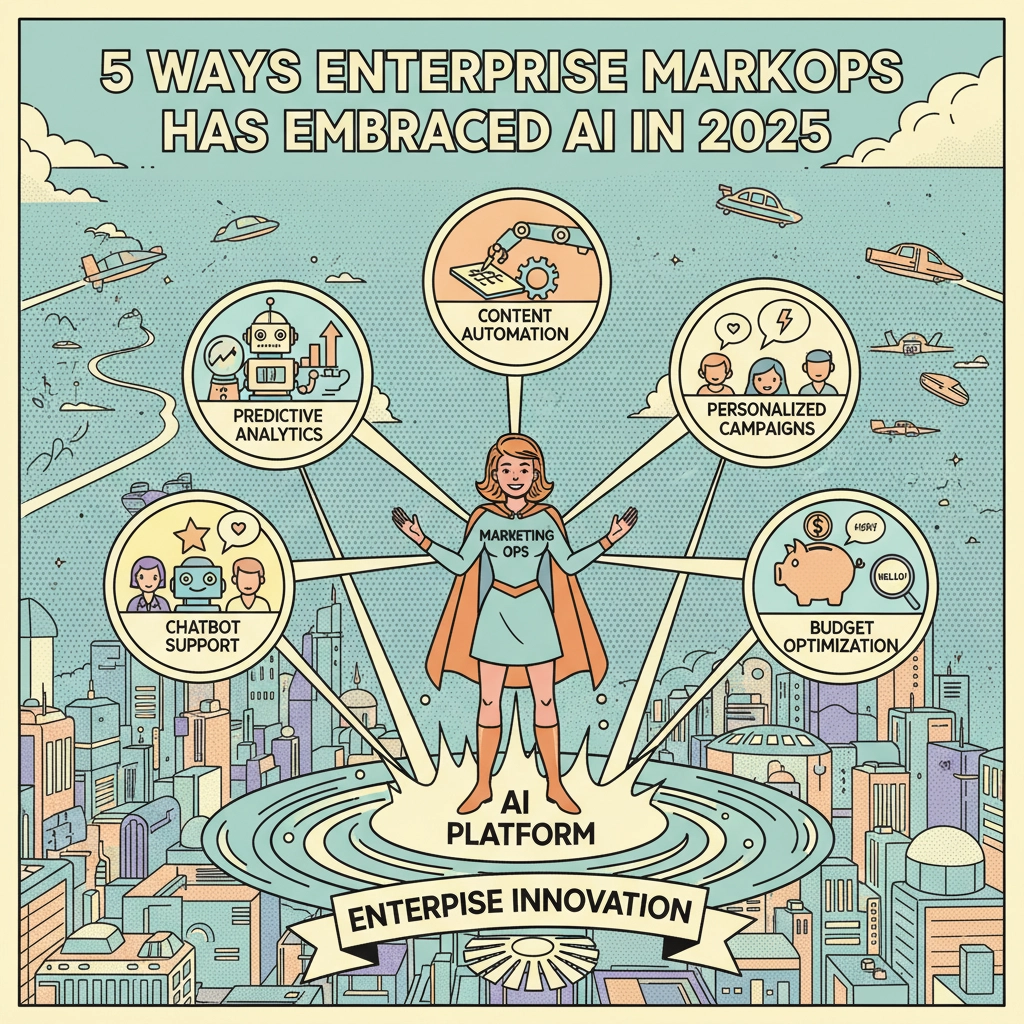
As we close out 2025, one thing has become crystal clear: enterprise marketing operations teams aren't just experimenting with AI anymore: they're making it the backbone of their entire strategy. While smaller companies are still figuring out where to start, enterprise MarkOps leaders have moved well beyond pilot programs into full-scale AI transformation.
The results? Revenue attribution that actually makes sense, campaigns that optimize themselves, and marketing budgets that work harder than ever before. But here's what's really interesting: the companies winning with AI in MarkOps aren't necessarily the ones with the biggest tech budgets. They're the ones that identified the right use cases and executed strategically.
Let me walk you through the five ways enterprise MarkOps teams have genuinely embraced AI this year, along with the practical implementations that are actually moving the needle.
1. Predictive Lead Scoring That Actually Predicts Revenue
Traditional lead scoring feels almost quaint now. Enterprise MarkOps teams have moved far beyond simple demographic and behavioral point systems into AI models that can predict not just conversion likelihood, but lifetime value, deal size, and sales cycle length with remarkable accuracy.

What's Really Happening: Companies like Salesforce and HubSpot customers are feeding their AI models everything: historical deal data, engagement patterns, technographic information, even external data sources like company growth signals and hiring patterns. The AI isn't just saying "this lead is hot": it's saying "this lead has an 85% probability of becoming a $50K customer within 90 days, and here's exactly why."
Take Microsoft's enterprise customers, for example. They're using AI lead scoring that incorporates over 200 data points, including how leads interact with specific content types, their company's technology stack, and even their competitors' recent activities. The result? Sales teams are focusing on leads that are 4x more likely to close, and marketing spend is being allocated to channels that produce higher-value prospects.
Implementation Reality: This isn't about buying a new tool: it's about training models on your specific data. The enterprises succeeding here are combining first-party customer data with intent signals, firmographic data, and engagement histories to create scoring models that understand their specific customer journey patterns.
2. Autonomous Campaign Orchestration Across Every Channel
The days of manually building campaign workflows are over for enterprise MarkOps teams. AI-driven campaign orchestration platforms are now managing complex, multi-channel customer journeys that adapt in real-time based on individual prospect behavior and market conditions.
What This Looks Like in Practice: Imagine a prospect downloads a whitepaper, but instead of triggering a static email sequence, AI analyzes their company size, technology stack, recent website behavior, and similar customer patterns to determine the optimal next touchpoint. Maybe it's a personalized video email from a sales rep. Maybe it's a LinkedIn ad for a specific product demo. Maybe it's enrollment in a webinar series tailored to their industry vertical.
Companies using platforms like Marketo, Pardot, and newer AI-native tools like 6sense are seeing campaign performance improvements of 35-60% because every interaction is optimized for the specific prospect's likelihood to progress through the funnel.
The Game-Changer: These systems are learning from every interaction across all prospects to continuously improve campaign logic. When a particular sequence doesn't work for software companies with 500+ employees, the AI adjusts automatically for similar prospects going forward.
3. Real-Time Revenue Attribution That CFOs Actually Trust
CFOs have been asking the same question for decades: "Which marketing activities actually drive revenue?" In 2025, enterprise MarkOps teams finally have AI-powered attribution models sophisticated enough to answer that question with confidence.
Traditional last-touch or first-touch attribution never told the whole story. Multi-touch attribution was better, but still relied on simplified models. Now, AI attribution platforms are analyzing the complex reality of modern B2B buying journeys: multiple stakeholders, long sales cycles, and touchpoints across dozens of channels.
Real-World Application: Enterprise teams are using AI attribution to understand that while a particular webinar might not generate immediate leads, prospects who attend are 3x more likely to engage with sales outreach six months later. Or that LinkedIn ads combined with retargeting campaigns create a multiplier effect that traditional attribution models completely missed.
Companies implementing solutions like Bizible, Dreamdata, or building custom attribution models are seeing marketing budgets increase because they can finally prove ROI with statistical confidence rather than educated guesses.
4. Content Generation and Optimization That Scales With Quality
Enterprise MarkOps teams aren't just using AI to generate more content: they're using it to generate better content at scale. This goes far beyond ChatGPT-generated blog posts into sophisticated content intelligence that understands audience preferences, competitor positioning, and conversion optimization.

How It's Actually Working: AI content platforms are analyzing which messaging resonates with specific personas, what content formats drive the most engagement at different funnel stages, and how to optimize everything from email subject lines to landing page headlines for maximum conversion.
But here's what's really impressive: the AI is learning from content performance data to suggest not just what to create, but when to publish it, how to distribute it, and which calls-to-action will perform best with specific audience segments.
Enterprise Implementation: Large MarkOps teams are using AI to maintain brand consistency across hundreds of content pieces while personalizing messaging for different industries, company sizes, and buying stages. The result is content that feels personally crafted but operates at enterprise scale.
5. Intelligent Budget Allocation That Maximizes ROI Automatically
Perhaps the most sophisticated AI adoption in enterprise MarkOps is automated budget optimization. Instead of quarterly budget reviews and manual reallocation, AI systems are shifting marketing spend in real-time based on channel performance, market conditions, and predicted outcomes.
The Practical Reality: AI budget optimization platforms analyze performance across all marketing channels: paid search, social, content syndication, events, email: and automatically shift budget toward the highest-performing activities. But it goes deeper than simple performance metrics.
These systems consider seasonality, competitive landscape changes, and even external economic factors. When the AI detects that a particular audience segment is becoming more price-sensitive, it might automatically reduce spend on premium positioning ads and increase budget for ROI-focused messaging.
Enterprise Results: Companies implementing AI budget optimization are seeing 20-40% improvement in overall marketing ROI because budget decisions are made based on real-time data rather than quarterly planning cycles and human intuition.
The Implementation Reality Check
Here's what's important to understand about enterprise AI adoption in MarkOps: success isn't about having the most sophisticated technology. It's about having clean data, clear objectives, and the organizational alignment to act on AI insights.
The enterprises winning with AI in 2025 started with specific, measurable problems: lead quality, attribution accuracy, campaign performance: and implemented AI solutions systematically rather than trying to transform everything at once.
They also invested heavily in data infrastructure and team training. AI is only as good as the data it learns from and the humans who interpret its outputs.
What This Means for Your MarkOps Strategy
If you're leading marketing operations at an enterprise company, the question isn't whether to adopt AI: it's how quickly you can implement it strategically. The companies that moved early in 2025 are already seeing compound benefits as their AI models become more sophisticated and their teams become more AI-fluent.
The good news? Most of these AI capabilities can be implemented incrementally. You don't need to rebuild your entire MarkOps stack overnight. Start with one area: maybe lead scoring or campaign optimization: prove ROI, and expand from there.
The enterprises that will dominate in 2026 are the ones implementing AI in MarkOps right now. Not as a nice-to-have experiment, but as a fundamental part of how they drive revenue growth.
Ready to explore how AI can transform your marketing operations? Learn more about our Revenue Operations AI consulting and discover how we help enterprise teams implement AI strategically for maximum impact.

