
Future-Proof Your Pipeline: The Top AI-Powered Growth Strategies for 2026
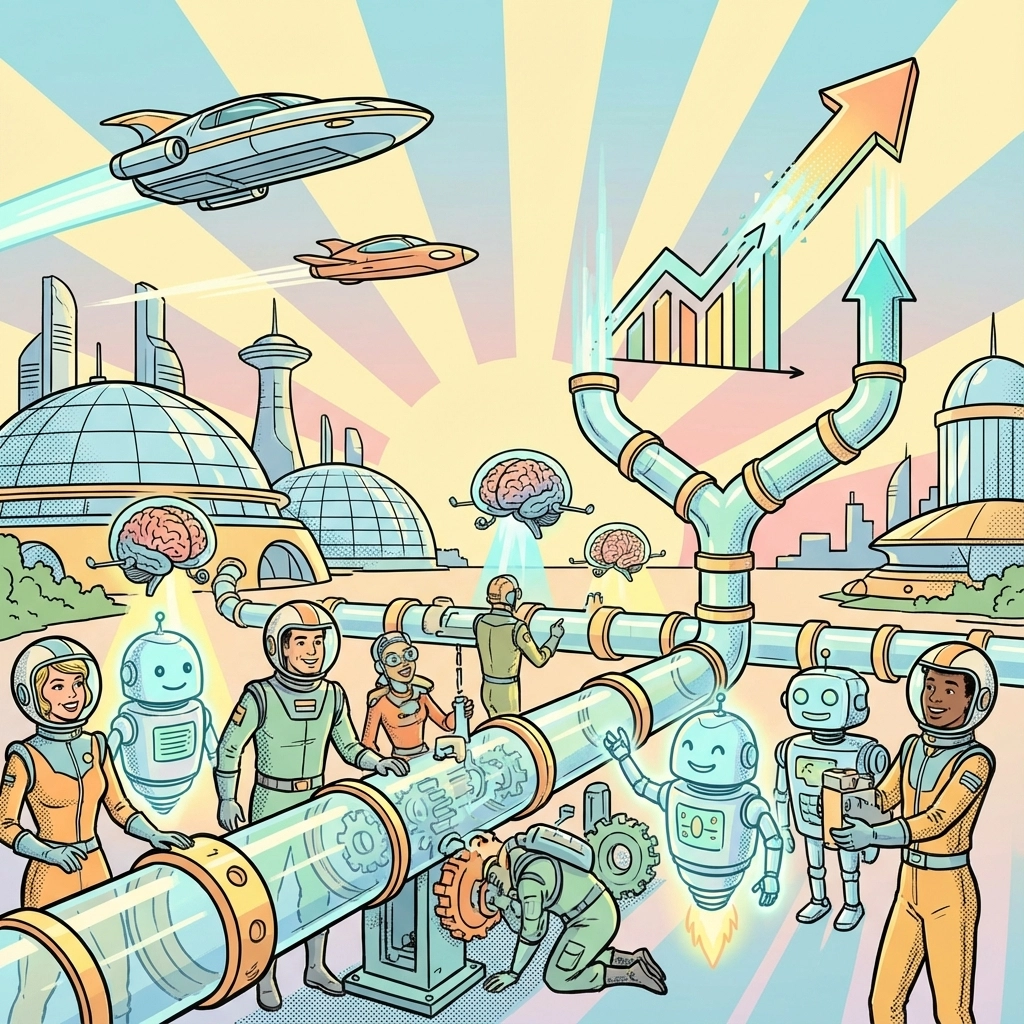
Let’s be honest, if you’re still treating AI like a shiny toy instead of a growth engine, you’re already behind. While your competitors are busy crowdsourcing random AI experiments across departments, the smartest B2B SaaS companies are building systematic, pipeline-focused strategies that’ll dominate 2026.
I’ve seen firsthand how organizations that get this right can transform their revenue operations from chaotic guesswork into predictable growth machines. The difference? They’re not chasing every AI trend that pops up on LinkedIn. Instead, they’re focusing on proven strategies that actually move the needle.
Here’s what you need to know to future-proof your pipeline and leave your competition scrambling to catch up.
Stop the AI Chaos: Why Enterprise-Wide Strategy Beats Department Experiments
You know that feeling when every department is running their own AI pilot project, and nobody can explain how any of it connects to revenue? Yeah, that’s exactly what you need to stop doing in 2026.
The organizations winning with AI aren’t crowdsourcing innovation: they’re taking a focused, leadership-driven approach. Senior leaders identify specific workflows with high-impact payoff potential, then allocate the right talent, technical resources, and change management support to drive actual results.
Here’s how to implement this strategy:
Start with your biggest revenue bottlenecks. Is your sales team spending 60% of their time on admin work? Are marketing qualified leads sitting in limbo for days? Pick one critical workflow that’s costing you deals.
Build cross-functional AI governance from day one. This isn’t about creating bureaucracy: it’s about ensuring your AI investments actually scale. Establish clear principles around human oversight, data privacy, and decision contestability before you deploy anything.
Measure impact, not activity. Don’t track how many AI tools you’re using. Track how much faster you’re converting leads, how much more accurate your forecasts are, and how much revenue you’re generating per sales rep.
Agentic AI: Your Secret Weapon for Pipeline Acceleration
While everyone’s still figuring out ChatGPT, smart RevOps leaders are already deploying agentic AI: and the numbers are staggering. We’re looking at market growth from $12-15 billion in 2025 to $80-100 billion by 2030, with a 40-50% compound annual growth rate.
But here’s the key insight most companies miss: treat agentic AI as infrastructure, not point solutions.
Think of it this way: instead of having separate AI tools for lead scoring, email sequencing, and pipeline forecasting, you’re building intelligent agents that can handle entire revenue workflows autonomously. One agent might manage the complete lead-to-customer journey, making real-time decisions about pricing, messaging, and follow-up timing.
Quick implementation strategy:
- Start with deterministic workflows where you already have clear rules and processes
- Build governance into the agent design, not as an afterthought
- Focus on workflows that directly impact revenue velocity: lead qualification, deal progression, customer expansion
The companies that nail this early will have such a competitive advantage that their slower competitors won’t be able to catch up, even with bigger budgets.
Your Data Foundation: The Make-or-Break Factor
Here’s a reality check: if your data is a mess, your AI strategy will be a mess too. I’ve watched companies spend six figures on AI tools only to realize their customer data is scattered across fifteen different systems that don’t talk to each other.

The enterprise AI transformation market is valued at $500-600 billion and growing at 34-35% annually. Within that massive market, $200-250 billion is flowing into data enablement: because smart leaders know this is the foundation that makes everything else possible.
Your 2026 data modernization playbook:
Audit your current state ruthlessly. Map every customer touchpoint, every data source, every integration. If you can’t explain exactly how a lead becomes a customer in your system, start there.
Prioritize real-time data flows. AI doesn’t work with stale data. Your systems need to update customer behavior, engagement scores, and buying signals in real-time to make intelligent decisions.
Build for AI consumption from the start. Structure your data so AI agents can easily access, understand, and act on it. This means clean schemas, consistent naming conventions, and automated data quality checks.
Companies that modernize their data foundations in early 2026 will be positioned to win. Everyone else will be stuck trying to run sophisticated AI on broken data infrastructure.
Governance as Growth Strategy, Not Growth Killer
Let’s address the elephant in the room: AI governance sounds boring, but it’s actually your competitive advantage. While 72% of enterprise leaders cite regulatory compliance as a major challenge, the companies that solve this early will move faster than everyone else.
Think of governance as your growth accelerator, not your brake pedal. When you have robust AI governance built into your processes, you can deploy new strategies faster because you’re not worried about compliance issues, data breaches, or algorithmic bias.
Smart governance moves for 2026:
Embed testing and validation into every AI deployment. Don’t just check if your AI is working: continuously validate that it’s making decisions that align with your business objectives and ethical standards.
Build transparency into your AI decision-making. When your AI agent decides to prioritize one lead over another or suggests a specific pricing strategy, your team should be able to understand and challenge that logic.
Create feedback loops that improve performance. Use governance data to make your AI smarter, not just compliant.
The organizations that crack this code will be able to innovate and deploy new AI strategies at lightning speed while their competitors are still stuck in legal review.
Workforce Strategy: Amplifying Human Potential
Here’s where most AI conversations get it wrong: this isn’t about replacing your team. It’s about transforming them into revenue superhumans.
Forward-thinking enterprises are already seeing 5x productivity gains from AI-driven tools, particularly for technical teams. But instead of outsourcing everything to vendors, they’re keeping talent in-house to capture that value directly.
How to restructure your revenue team for AI amplification:
Redefine roles around AI collaboration. Your sales reps become deal orchestrators, using AI to handle research, follow-ups, and proposal generation while they focus on relationship building and strategic conversations.
Invest in AI-human workflow training. Don’t just give your team AI tools: teach them how to work symbiotically with AI agents to maximize results.
Create career paths that include AI mastery. The most valuable employees in 2026 will be those who can seamlessly collaborate with AI to achieve superhuman results.
Your 2026 Growth Action Plan
Ready to future-proof your pipeline? Here’s your immediate next steps:
Week 1: Audit your biggest revenue bottlenecks and identify one high-impact workflow for AI transformation.
Month 1: Establish AI governance principles and begin data foundation modernization.
Quarter 1: Deploy your first agentic AI agent on a proven workflow with strong governance integration.
Quarter 2: Scale successful implementations and begin workforce transformation initiatives.
The window for competitive advantage is closing fast. While your competitors are still debating which AI tools to try, you can be building the systematic, pipeline-focused AI strategy that will dominate your market in 2026.
The question isn’t whether AI will transform B2B SaaS growth: it’s whether you’ll be leading that transformation or scrambling to catch up. The choice is yours, but the time to act is now.
Ready to build your AI-powered growth strategy? Let’s talk about how FusedLabs can help you implement these strategies and leave your competition wondering what hit them.

