
The Content Factory vs. The AI Lab: Why Scaling Marketing Isn’t About More Headcount
You’ve been lied to about scaling.
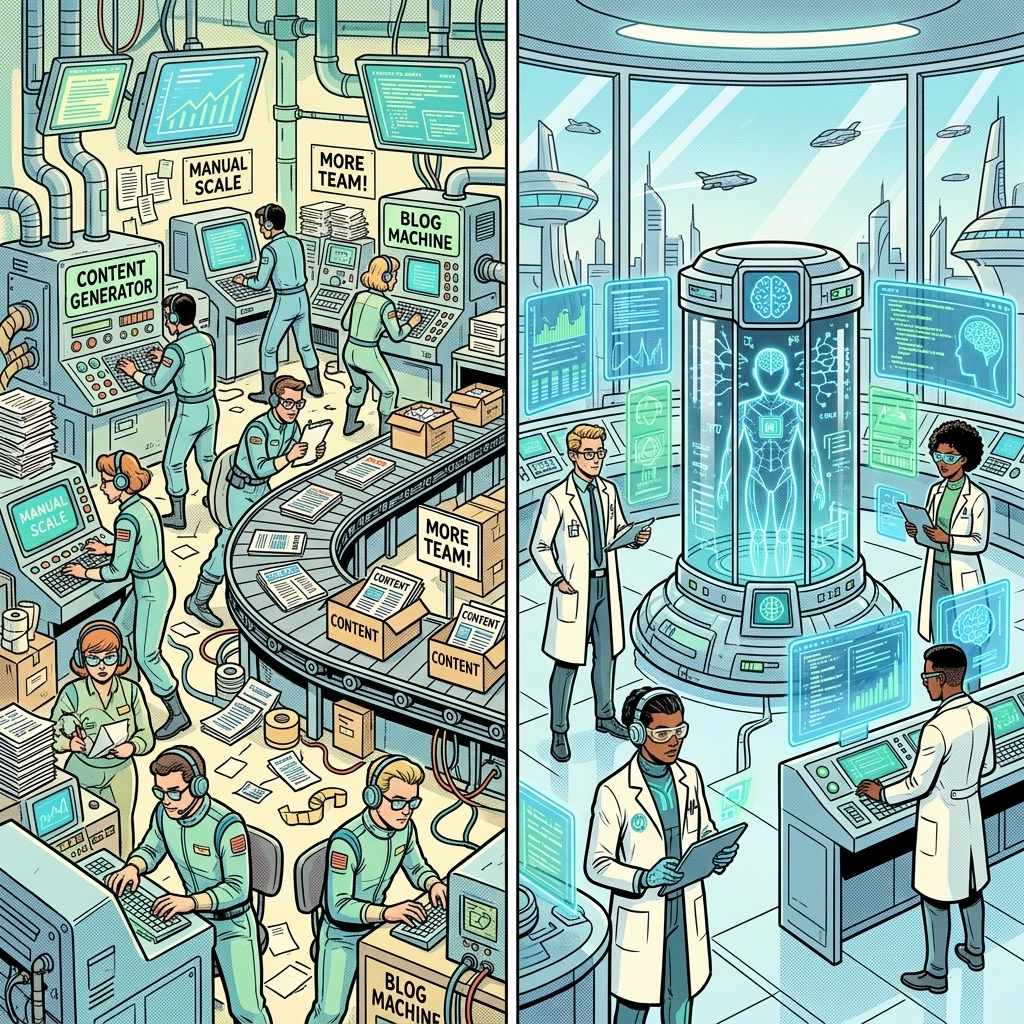
For the last decade, the playbook for B2B SaaS marketing has been remarkably simple: if you want more leads, you hire more people. You hire a content manager, then a social media specialist, then an SEO lead, and eventually a fleet of junior copywriters to feed the beast. We’ve treated marketing like a 19th-century textile mill: a “Content Factory” where the only way to increase output is to add more bodies to the assembly line.
But here’s the reality you’re likely facing right now: your team is burnt out. The cost of customer acquisition (CAC) is skyrocketing. And despite having a larger headcount than ever, your production speed is stuck in the mud.
You don’t have a people problem. You have a production bottleneck that more people will never fix.
In this new era of the AI-driven buyer journey, scaling isn’t about headcount. It’s about shifting from the “Content Factory” to the “AI Lab.” It’s about building custom AI apps that own specific creative workflows, turning your marketing team from manual laborers into systems architects.
The Death of the Content Factory
The Content Factory model is built on linear growth. If one person can write four blog posts a month, then two people can write eight. It sounds logical on a spreadsheet, but it fails in the real world.
Why? Because humans don’t scale linearly. As you add people, you add “organizational debt.” You add more Slack channels, more status meetings, more approval layers, and more brand-voice inconsistencies. Suddenly, your “Factory” is spending 60% of its time on coordination and only 40% on actual creation.
I’ve seen this firsthand at dozens of SaaS companies. They hit a wall where adding the next marketer actually slows down the output. This is the manual production bottleneck. You’re asking humans to do “grunt work”: formatting emails, tagging assets, rewriting the same value prop for five different personas: that kills their creative energy.
When you’re under pressure to scale, the instinct is to open a new job req. I’m telling you to hold your horses.

Enter the AI Lab: Building Custom Apps, Not Teams
The alternative is the “AI Lab.” In this model, you don’t hire a person to solve a bottleneck; you build a custom AI app to vaporize it.
When we talk about “AI apps” at FusedLabs, we aren’t talking about giving your team a ChatGPT login and wishing them luck. Generic AI is just a faster typewriter. A custom AI app is a piece of infrastructure. It’s a tool built specifically for your brand, your product data, and your unique GTM strategy.
Think of it this way:
- The Content Factory hires a writer to look at product usage data and manually draft a “Year in Review” email for 500 different customers.
- The AI Lab builds an app that connects directly to the product database, analyzes user behavior, and generates 5,000 hyper-personalized narratives in seconds.
The Lab focuses on enterprise GTM AI strategy. It views marketing as a series of data-driven workflows that can be automated. This doesn’t replace the marketer; it elevates them. Your team moves from doing the work to directing the apps that do the work.
Why Custom Apps Beat Generic Tools
You might be thinking, “We already use AI tools.” But there is a massive difference between a SaaS tool you subscribe to and a custom AI app you own.
Generic tools are built for the “average” company. They don’t know your specific ICP (Ideal Customer Profile). They don’t understand the nuance of your “Product-Led Growth” (PLG) motion. They don’t have access to your internal data silos.
A custom AI app, architected by experts who understand the flow from application to GTM stack, becomes your unfair advantage. It allows you to:
- Own the Context: Your app is trained on your best-performing whitepapers, your brand guidelines, and your winning sales decks.
- Eliminate Friction: It lives where your data lives. No more “copy-pasting” from the product dashboard into an AI prompt.
- Scale Content without Fatigue: An AI app doesn’t get “writer’s block” at 4:00 PM on a Friday. It maintains 100% brand consistency whether it’s generating one asset or one thousand.
Architecting the Data Bridge
This is where most marketing teams stumble. They want the magic of AI, but their data is a mess.
At FusedLabs, we believe that AI is only as good as the data flow supporting it. If your product usage data is trapped in a silo and your marketing automation is living in another, your AI is effectively blind. You can’t build an AI-driven buyer journey if the “brain” doesn’t know what the user is doing.
To move from Factory to Lab, you have to bridge the gap between your application and your GTM stack. When that bridge exists, you can build apps that don’t just “write,” but “react.” Imagine an AI agent that notices a lead has been stuck in a specific stage of your trial for three days and automatically generates a custom tutorial video and email sequence tailored to the exact feature they’re struggling with.
That isn’t a “marketing task.” That’s a custom AI application removing a production bottleneck in real-time.

How It Relieves the Bottleneck
So, how does this actually change your day-to-day? It removes the “production lag.”
In the old model, a new product feature launch would take weeks of marketing preparation.
- Copywriters draft the announcement.
- Designers create the assets.
- Ops sets up the tracking.
- Social teams schedule the posts.
In the AI Lab model, you have an “Asset Engine” app. You feed it the product spec, and it automatically generates the email copy, the LinkedIn carousels, the blog post summary, and the ad variants: all in your brand voice, all instantly.
The human marketer becomes the Editor-in-Chief. They review, they tweak, and they hit “go.” You’ve just collapsed a two-week production cycle into two hours.
This is how you scale without adding headcount. You’re not asking your people to work harder; you’re giving them a power plant to run.
The Shift in Mindset
Moving to an enterprise GTM AI strategy requires a visionary shift. You have to stop looking at your budget in terms of “Full-Time Equivalents” (FTEs) and start looking at it in terms of “Automated Outcomes.”
If you spend $150k on a new hire, you get one person’s worth of output. If you spend that same amount building a suite of custom AI apps, you get an infinite, scalable production line that lives in your stack forever.
It’s about moving from being reactive to being architectural.
https://fusedlabs.com/revops-ai-insights/accelerating-growth-how-ai-is-your-startups-assembly-line
What’s Next?
This is just the beginning of the journey. In the next part of this sequence, we’re going to dive deep into The Data Bridge. We’ll show you exactly how to pipe your raw product usage data into a custom AI agent that doesn’t just talk to your customers, but understands them.
If you’re tired of the headcount trap and ready to start building your Lab, let’s talk. At FusedLabs, we don’t just give you tools; we architect the future of your revenue operations.
The “Content Factory” is closing its doors. It’s time to start experimenting.
Ready to vaporize your production bottlenecks?
Explore how FusedLabs architects GTM AI strategy.


