
The Death of the Siloed Executive: Why Your 2026 Revenue Strategy Demands a Unified Command

Here's the uncomfortable truth: if your VP of Sales, CMO, and Head of Customer Success are still running independent kingdoms in 2026, your enterprise GTM is already behind.
The walls are crumbling. Not because of some feel-good corporate mandate about "collaboration," but because the math simply doesn't work anymore. When your Sales team is optimizing for closed deals, Marketing is chasing MQLs, and CS is fighting churn in isolation, you're not running a revenue engine: you're running three separate machines that occasionally bump into each other.
And in 2026, that's a death sentence.
Why Silos Are Finally Dying (And Why Now)
For years, we tolerated siloed executives because we didn't have a better option. Marketing had their stack, Sales had theirs, and CS lived in a completely different universe of tools and metrics. Everyone reported up through different spreadsheets, different dashboards, different truths.
But three things changed:
First, buyer behavior evolved faster than our org charts. Your prospects don't experience your company in silos: they're touching Marketing content, engaging Sales reps, and reading CS reviews simultaneously. They expect a unified experience, and when they don't get it, they bounce.
Second, the data explosion made fragmented reporting not just inefficient but actively dangerous. When your CMO reports 500 MQLs but your CRO sees only 50 SQLs, and your CS team is screaming about product fit issues that Sales "forgot" to mention: you're not making decisions. You're gambling.
Third, and most importantly: AI-driven revenue operations finally gave us the technology to actually fix this. Not with more Slack channels or quarterly alignment meetings, but with intelligent systems that break down data barriers and create a single source of truth.

The Fragmented Reporting Nightmare You're Living Right Now
Let me paint a picture you'll recognize.
It's Monday morning. Your CMO walks into the executive meeting with a deck showing a 40% increase in pipeline generation. Your VP of Sales counters with data showing pipeline quality has never been worse. Your CS leader chimes in that the accounts Marketing is "generating" have a 60% higher churn rate than organic inbound.
Who's right? Everyone. And no one.
This is what fragmented reporting looks like in 2026: and it's killing your CRO efficiency faster than any external market force. Each executive is optimizing their slice of the revenue engine without seeing how their decisions ripple through the entire system.
Marketing pumps volume without visibility into Sales capacity or CS delivery capabilities. Sales closes deals that Customer Success can't retain because nobody shared the implementation complexity. CS identifies expansion opportunities that never make it back to Sales because the feedback loop is a quarterly email thread.
You end up with what I call "aggressive agreement": everyone nodding in the same meetings while executing completely different strategies.
What "Unified Command" Actually Means (And Why Military Metaphors Finally Make Sense)
The term "unified command" comes from military doctrine, but don't worry: I'm not about to tell you to run your revenue team like an army battalion.
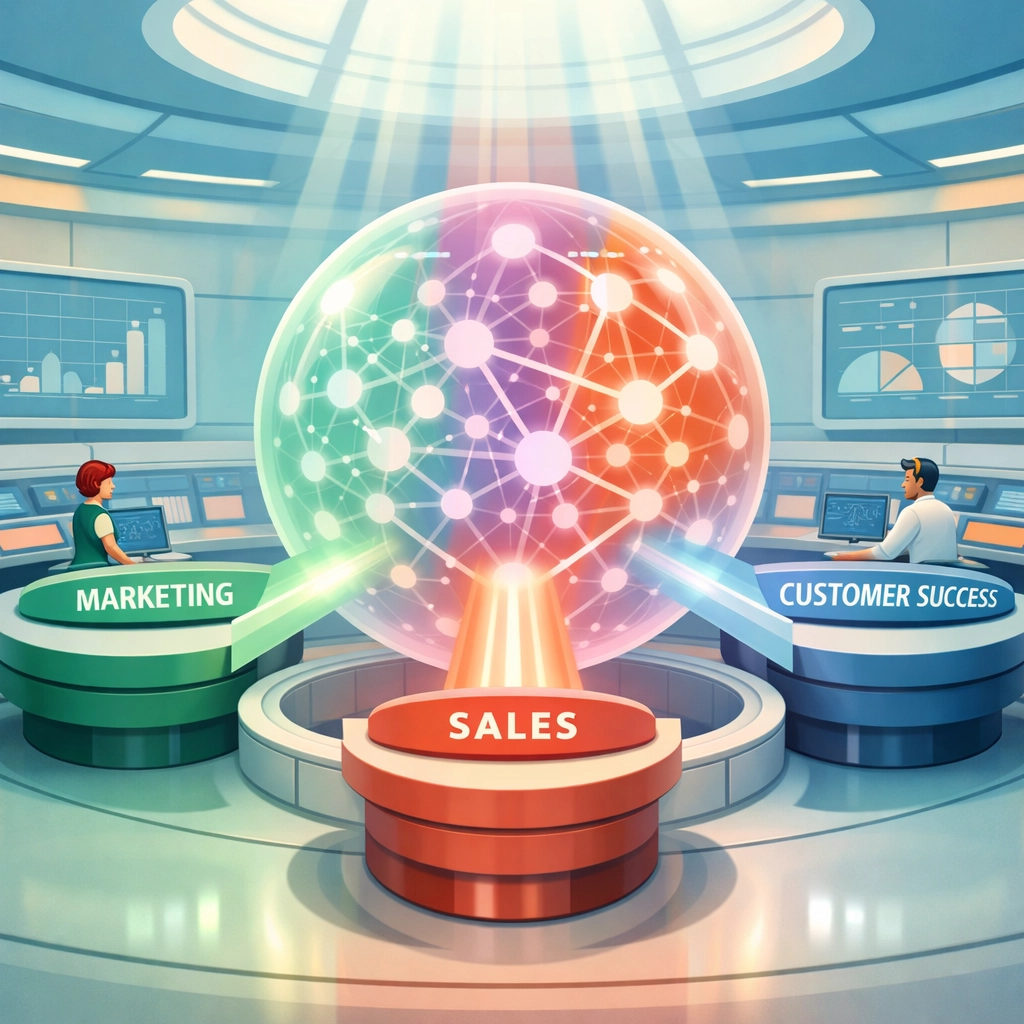
Instead, think about what unified command actually enables: a single operational picture that every decision-maker can see and act on simultaneously.
In enterprise RevOps terms, this means:
- One revenue truth: Not Marketing's truth or Sales' truth, but a single, AI-enriched view of your entire customer journey from first touch to expansion.
- Shared objectives that actually align: When everyone can see the same leading indicators, the same bottlenecks, and the same opportunities, you stop optimizing for departmental metrics and start optimizing for revenue.
- Real-time orchestration: Your systems talk to each other faster than your executives can Slack each other. When Marketing identifies a high-intent account, Sales gets notified automatically. When CS flags expansion potential, it flows back into targeting models instantly.
This isn't about organizational restructuring or adding another "Chief Revenue Officer" layer. It's about building revenue orchestration into your technical infrastructure so that unified strategy becomes the default, not the aspiration.
Why 2026 Is The Actual Tipping Point
You've heard "this is the year of X" predictions before. Usually, they're wrong.
But 2026 is different for enterprise GTM, and here's why:
The AI maturity cliff is here. Companies that spent 2024-2025 building clean data foundations and experimenting with revenue operations AI are now seeing compounding returns. They're making decisions in hours that used to take quarters. Meanwhile, companies still stuck in siloed reporting are falling further behind every month.
Investors are demanding unified metrics. Gone are the days when you could show a board three different versions of "growth" and get away with it. Modern investors want to see unified CAC payback, net revenue retention that includes all GTM costs, and pipeline conversion rates that don't mysteriously change between Marketing and Sales decks.
Your best talent won't tolerate it anymore. Top-tier GTM leaders increasingly refuse to join companies with fragmented tech stacks and siloed reporting. They've seen what's possible with unified command, and they're not interested in fighting the spreadsheet wars anymore.
The companies that crack this in 2026 will build an insurmountable advantage. The ones that don't will keep wondering why their "record pipeline" never converts to record revenue.
How AI Enables Unified Command (Without The Restructuring Nightmare)
Here's the good news: you don't need to blow up your org chart to achieve unified command. You need to upgrade your infrastructure.
Modern revenue operations AI acts as the connective tissue between your siloed systems, creating that single operational picture without forcing everyone into a single monolithic platform.
Think of it this way:
Layer 1: Unified Data Foundation
AI-powered data enrichment and hygiene automatically resolve conflicts between how Marketing defines an account versus how Sales defines it versus how CS defines it. No more "is this company one account or three?" debates.
Layer 2: Cross-Functional Intelligence
Machine learning models that understand the entire customer journey: not just the Marketing funnel or the Sales cycle or the CS health score, but the complete picture. These models identify patterns that no single executive could see from their silo.
Layer 3: Automated Orchestration
Smart workflows that trigger actions across teams based on unified signals. When an account shows both high intent (Marketing signal) and relationship strength (Sales signal) and expansion potential (CS signal), the system orchestrates the next moves across all three teams automatically.
This is how you move from fragmented reporting to unified command without the six-month "alignment initiative" that everyone dreads.

What This Looks Like In Practice
Let's get concrete. Here's what Monday morning looks like with unified command:
Your CMO, VP of Sales, and CS Leader walk into the executive meeting looking at the same dashboard. Not three dashboards that theoretically align, but literally the same real-time view.
They see that Enterprise pipeline is up 40%, but the AI models are flagging that 30% of those opportunities have low product-fit scores based on CS implementation data. Instead of arguing about whether to celebrate the growth or worry about the quality, they immediately pivot to: "What do we do about it?"
Marketing adjusts targeting to prioritize accounts that match the high-retention profile CS has identified. Sales gets automated alerts about which opportunities to double-down on versus which to qualify out early. CS proactively engages new deals that match historically complex implementation patterns.
All of this happens in a single meeting because everyone is operating from the same source of truth. No political maneuvering, no data disputes, no aggressive agreement followed by siloed execution.
That's unified command.
The Question Isn't "Should We?" Anymore
The question is whether you'll build unified command before your competitors do.
Because here's what's happening right now: the enterprise GTM leaders who embraced AI-driven revenue operations early are pulling away from the pack. They're converting pipeline faster, retaining customers better, and expanding accounts more efficiently: not because they work harder, but because they have a clearer picture of what's actually happening.
Meanwhile, companies still running on siloed reporting are burning budget on initiatives that work against each other, celebrating vanity metrics that don't convert to revenue, and watching their best GTM talent leave for organizations that have their act together.
The death of the siloed executive isn't a prediction. It's already happening.
The only question is whether you'll lead the change or become a cautionary tale.
If you're ready to stop fighting the spreadsheet wars and start building unified command into your revenue engine, let's talk about how AI-driven RevOps makes it possible—or go deeper here: https://fusedlabs.com/ai-driven-revenue-operations/. Because in 2026, the companies that win won't just have better strategies (they'll have better infrastructure to execute them.)

